Piranha Options Trading
TURNING SMALL BITES INTO LARGE PROFITS

Using Puts for Asset Protection
Put options are common in stock trades and often offer an advantage when compared to a standard “buy and hold” stock position. There are many different ways to use options to enhance a position. In this section we will cover, buying a put to guarantee a sale of stock, Selling a Put to buy stock, and selling a put to earn income.

Buying Put Options for asset protection is a very common practice for investors, and is like buying accident insurance. Investors will buy puts at or just below the current trade price to lock in profits, in a volitle market. In the event of a market crash, the stock will be automatically sold at the price of the put contract purchased and protected from any further decline in value.
Look at the following example.
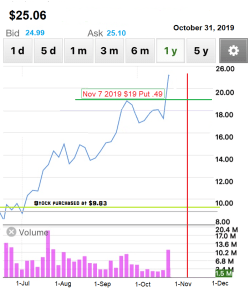
In this example XYZ stock was purchased for $9.83 per share. Since then, the stock has more than doubled in price, and is trading for 19.00 per share. If the stock price drops, the gains would be wiped out. So to protect the investment from sudden loss, a put contract could be purchased as insurance policy. In the illustration, an $19 put could be purchased for cents per share. For example, a put contract to protect 500 shares would cost $140, 500 x .49= 245. This Put contract would guarantee the sale price of $19 if the stock price were to fall below that level before the expiration date Nov 7,2019, as shown in the example. This is only one week of protection, so additional puts would have to be purchased with later expiration dates to further protect the investment. Typically options can be purchased for weeks or months and sometimes a year into the future.
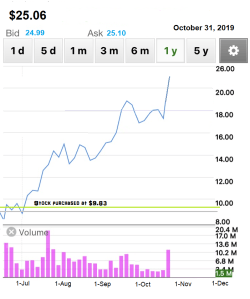
Position 1 – no options.
Purchase 500 shares@9.83 the stock soars to $25 by the last week of October. Rather than sell the stock and cash in, it is decided to hold on for potentially higher profits………
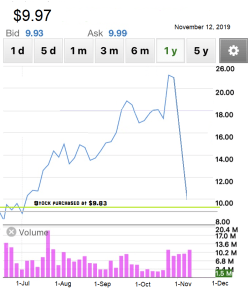
Then some unexpected news is released causing the stock price to fall. Over the next few days the stock price continues to fall, closing at 9.97
Even though the stock is held for the entire 6 months, and the stock made a record high, the net gain would only be $70 if the stock is sold at the close. This is because, gains are only captured when the stock is sold.
Position 2 – using Put option
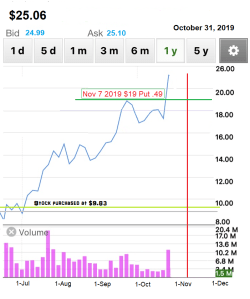
Using the same trade, purchase 500 shares @9.83. and the stock soars to $25 by the last week of October. At this point there is a substantial profit in the account. Since it is believed the price could continue much higher the stock is not sold. So in order to add some protection from total loss, a put option is purchased to cover 500 shares with a strike price of $19.00. This contract, in this example for a $19 put cost .49 cents per share and will expire on Nov 7 which is a week away. Using the option as protection, any loss will be limited by the value of the put contract, $19/share.
Oklahoma Sooner sports page. Scoops, photos, and updates for all things Sooner sports, plus plenty of recruiting content. Visit our website at http://theboomerbeat.com

StockTwits is a social media platform designed for sharing ideas between investors, traders, and entrepreneurs.

 Piranha Options Trading
You must be logged in to post a comment.